
Technology
How Weave S1 turns any display into a touchless interface.
How It Works
Weave S1 reads natural hand motion across a 185° field of view and maps it to the screen — so people control a display entirely in mid-air, with nothing to touch.
A compact stereo infrared sensor bar mounts to the bezel of any display and tracks 27 hand joints in real time. Hand position is converted into screen coordinates through ray casting — no gloves, no controllers, no contact.
Wide-Angle Hand Tracking
A 185°×185° field of view captures the whole hand even at extreme reach, so users can point and gesture from anywhere in front of a large display or kiosk.
Edge-Aware Stabilization
Wide lenses distort toward the edges. Our adaptive smoothing measures how far the hand sits from the sensor center and raises stability at the edges, removing the jitter that usually breaks wide-angle pointing.
Contactless Input
Because interaction happens in mid-air, there is no shared surface to touch — ideal for medical, public, and high-traffic environments where hygiene and durability matter.
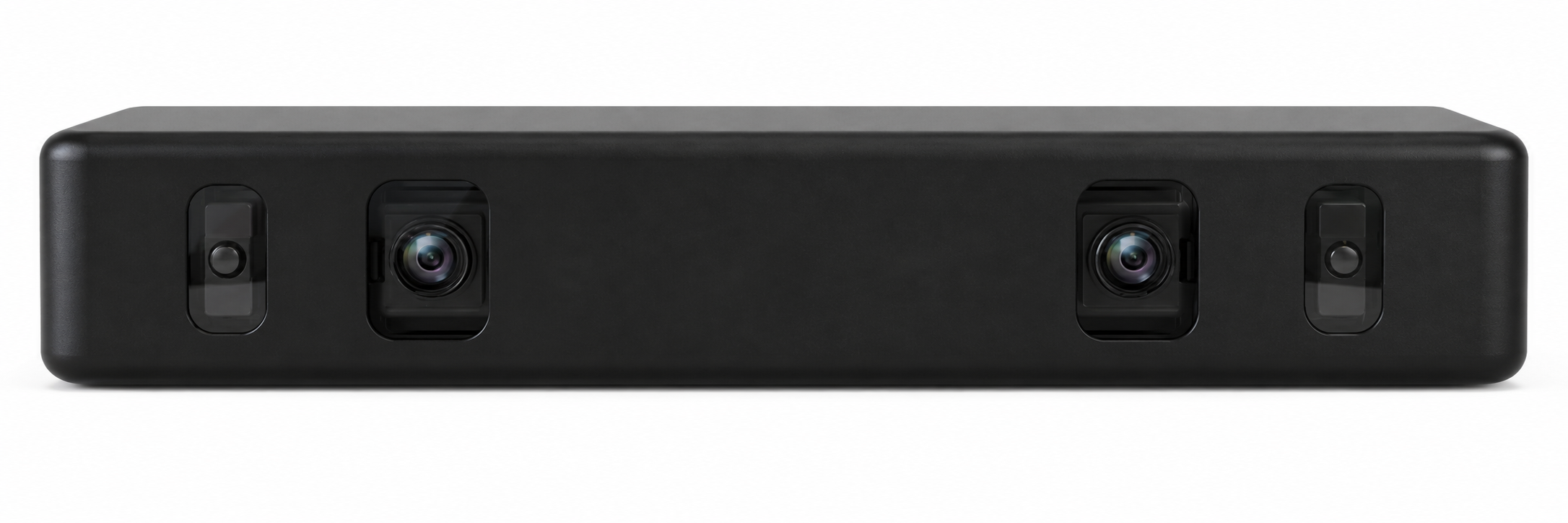
Product images are previews — the final product design may change.
What Makes Weave S1 Different
185° Coverage
A 185°×185° field of view captures the whole hand, even at extreme reach.
Hygienic by Design
No physical contact — nothing to touch, nothing to wipe down.
Precise Pointing
Edge-aware smoothing keeps the cursor stable, center to edge.
Easy Retrofit
The sensor bar mounts to any existing display or kiosk.
Real-time Response
90 fps stereo IR tracking turns hand motion into instant action.
Interaction That Just Works
A 185°×185° wide-angle sensor covers the full reach of a large display or kiosk, so a raised hand is tracked even at extreme lateral positions.
Full skeletal hand tracking resolves 27 distinct joints, enabling natural, expressive gestures rather than a single crude pointer.
Stereo infrared tracking runs at 90 frames per second, turning natural hand motion into instant, responsive on-screen action.
Where We’re Headed
Near Term
We focus on public and commercial deployments — touchless kiosks and interactive signage — where hygiene and everyday comfort drive adoption.
Long Term
We bring Weave S1 into mobility and medical systems — in-vehicle interfaces and sterile clinical environments.